


Warm or Cool Light? Choosing Colour Temperature (2700–4000K)
6 min reading time
6 min reading time
Colour temperature sets the mood of an interior as much as wall colour does. This guide explains the 2700-4000K scale, gives a room-by-room cheat sheet, and covers CRI 90+, tunable white and the mistakes that make good fixtures look wrong.
In short: colour temperature is measured in kelvin and describes the tint of the light, not how bright it is. For living spaces, 2700-3000K is the working range; 3500-4000K belongs in task and technical areas. Mixing temperatures inside one zone is the single most common lighting mistake we are asked to fix.
Colour temperature is measured in kelvin (K) and describes the tint of the emitted light — from warm yellow-orange to cool blue-white. It is not brightness: a 2700K lamp and a 4000K lamp can deliver identical lumen output and produce completely different atmospheres.
The lower the kelvin figure, the warmer and cosier the light. The higher it goes, the cooler and more alert it feels.
In premium residential work the range is almost always 2700-3000K, with 3500-4000K added only where a task demands it.
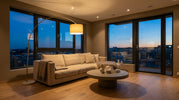
The same interior reads differently under different light. Warm light flatters timber, rattan and textiles; cool light emphasises the crispness of stone and metal but can tip a room into looking clinical.
One tropical caveat: in a villa with a lot of teak, rattan and warm stone, 2700K can read as heavy and yellow at midday when it competes with daylight. On Phuket projects we often land on 3000K for the main living layer and reserve 2700K for the evening scene through dimming — more on that below.
The simplest method is to work from the purpose of the room and the scenario in which it is used.
The cosiest, most relaxing light, with a soft golden cast. It creates an evening, intimate atmosphere.

The universal balance: still warm, but cleaner and crisper than 2700K. The safest single choice for a whole residence.

Clean, calm light with no pronounced warmth or coolness. Good where both comfort and legibility matter.

Alerting, contrasty light, close to daylight. It emphasises detail and surface, and supports concentration.
Above 4000K (5000-6500K) is generally avoided in residential interiors — the light becomes cold and tiring. The exception is genuinely technical space: a plant room or a workshop bench.

The short version: warmer for living, more neutral for working.
Temperature is only half the specification. The other half is quantity — how many lux land on the surface. The two are set together, and our lighting levels and lux guide covers the target figures per room.
Most lighting problems are not caused by the fixtures. They are caused by the wrong temperature, or by several temperatures colliding in one space.
Tip: hold one temperature within a zone, and create variety through brightness and scenes rather than by changing tint.
Two parameters get overlooked next to colour temperature, and both matter more than the kelvin number in a well-designed scheme.
For premium interiors we recommend CRI 90+ combined with scene control — that combination gives the most natural and flexible result, and it costs far less at design stage than as a retrofit.
Which is warmer, 2700K or 4000K?
The lower the kelvin figure, the warmer the light. 2700K is warm and golden; 4000K is cool-neutral and close to daylight.
What temperature should I use throughout a home?
3000K is the most universal single answer: warm enough for living areas without reading yellow. Raise it to 3500-4000K in kitchens and bathrooms.
What is best for a bedroom?
2700K. It relaxes and supports the wind-down before sleep. Cool light in a bedroom is counterproductive.
Can I mix warm and cool light in one room?
Within a single zone, hold one temperature. Add variety with brightness, scenes and accents rather than by changing tint. Different zones in an open plan can differ if the transition is deliberate.
Which matters more, temperature or CRI?
They are different parameters. Temperature sets the tint; CRI describes how naturally colours render. You need both — aim for CRI 90+.
What is tunable white?
Fixtures whose colour temperature can be changed — neutral during the day, warm in the evening. Useful in a room that serves several scenarios.
Does the tropical climate change the answer?
Indirectly. Bright daylight and warm timber finishes push the comfortable general-light figure towards 3000K rather than 2700K, and outdoors near a pool or the sea the driver is ingress protection and corrosion resistance as much as kelvin.
RODESIGNE designs & manufactures custom lighting for villas, hotels and restaurants — Phuket & worldwide. Send us a plan or a brief and we will come back with fixtures, colour temperature, CRI and a control scheme.
Technical & Architectural Lighting · Request a project estimate


