


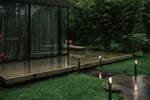
Villa Garden Lighting: How to Design Outdoor Light in Three Layers
7 min reading time
7 min reading time
Bollards every 3–5 m along paths, 3–5 uplit trees, warm 2700–3000 K everywhere and IP68 under water. A three-layer method for lighting a tropical villa garden — with all the numbers.
In short: good garden lighting is built in three layers — navigation (bollards along paths at 3–5 m intervals), accents (3–5 key trees uplit from below) and atmosphere (soft light around the terrace, sala and pool). Keep the whole picture warm at 2700–3000 K, aim light at objects rather than into the sky or bedroom windows, and in a tropical climate treat IP ratings as non-negotiable: IP65 in the open, IP67 in the ground, IP68 under water. Here is the full method, zone by zone — from the driveway to the pool edge.
A beautiful villa garden at night is not about the number of fixtures — it is about choreography. Light and darkness have to alternate.
The most common mistake is flooding everything with light. Depth comes from contrast: lit accents against dark pauses. If every shrub glows, the garden looks like a supermarket car park.
Tropical greenery and natural stone only come alive under warm light at 2700–3000 K — cool white makes foliage look grey and lifeless. And follow the dark-sky principle: fixtures should light an object, the ground or a wall, never the sky or a bedroom window.
Cable routes, conduits and transformers go in before paving and planting. Re-trenching under finished stonework is the most expensive mistake in landscape lighting — and in the tropics, every joint buried in the ground has to be sealed properly before the first monsoon rain tests it for you.
Four typical zones of a villa property — what to light and how.

Safety comes first: bollards 30–110 cm tall along walkways, with light directed down onto the surface so nothing shines in the eyes. At the gate and parking area — pole lanterns 3–4 m high or a pair of wall lights on the entrance.

The wow moment of any night garden is a tree lit from below: an in-ground uplight or spike spot at the trunk paints the canopy with light. A palm is the perfect subject — a narrow 15–25° beam grazes the trunk, a wider 40–60° beam opens up the crown.

Here light works for atmosphere, so keep brightness to a minimum: soft step lighting, wall fixtures by the seating, underwater IP68 light in the pool. Everything on dimmers — an evening by the water needs half-tones, not lux.

The facade ties the whole picture together: up-down wall lights following the rhythm of the windows, and the entrance door lit with fixtures mounted at 160–170 cm. In coastal air, materials matter as much as optics — brass and copper age gracefully, while cheap coated aluminium blisters within a couple of seasons.
Save this before you start the design.
Check your plan against these before anything is buried.
How many fixtures does a villa garden need?
Count by zones, not by pieces: bollards along the paths every 3–5 m, uplights on 3–5 key trees, 2–4 fixtures around the terrace and sala, a pair of wall lights at the entrance and a lantern at the gate. A typical villa plot of 1,000–1,500 m² lands at 15–25 fixtures. More is not better — the alternation of light and darkness is what gives the garden depth.
What should I install along a garden path?
Bollards 30–110 cm tall with light directed downwards: they illuminate the surface without glare. Space them 3–5 metres apart. A minimalist alternative is recessed in-ground markers set into the paving.
How do I uplight a palm or a large tree?
With an in-ground fixture or a spike spot at the base, beam aimed bottom-up: a narrow 15–25° beam for the trunk, a wide 40–60° beam for the crown, warm light at 2700–3000 K. A spike spot is the practical choice — it repositions as the tree grows.
Warm or cool light for the garden?
Only warm 2700–3000 K for the garden, facade and lounge areas — greenery and stone look alive. Leave cool 4000–6000 K to service zones such as parking. One consistent temperature across the whole property is the mark of a professional design.
Will outdoor fixtures survive tropical humidity and salt air?
Quality fixtures will — if you specify them correctly. Use IP65 minimum in the open, IP67 in the ground, IP68 under water, low-voltage 12/24 V near the pool, and marine-grade materials: 316 stainless steel, brass or copper for coastal properties. The weak point is never the fixture itself but unsealed connections — insist on gel-filled or resin connectors at installation.
Do I need a lighting plan, or can I improvise?
A small courtyard can be done by the rules in this article. For a full villa plot, a plan pays for itself: it fixes the zones, cable routes and controls before any earthworks. Re-trenching under finished paving costs several times more than designing the layout up front.
RODESIGNE designs and manufactures custom lighting for villas, hotels and restaurants — in Phuket and worldwide. Send us your site plan or even a few photos, and we will propose a zone-by-zone layout, specify fixtures rated for the tropical climate and price the complete package. Explore our Technical & Architectural Lighting services or request a project estimate.


