


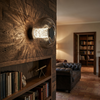
Wall Sconce Height Guide: Bedroom, Mirror, Living Room, Stairs
9 min reading time
9 min reading time
Sconce mounting heights that work: 120-140 cm (47-55 in) beside the bed, 155-165 cm (61-65 in) at eye level by the bathroom mirror, 160-180 cm (63-71 in) in living rooms, 150-160 cm above each stair tread. A room-by-room cheat sheet with wiring rough-in tips.
In short: the universal sconce height is 160-180 cm (63-71 in) from the floor to the center of the fixture. But every zone has its own correction: beside the bed — 120-140 cm (47-55 in), so you can read without glare hitting whoever is lying down; by the bathroom mirror — 155-165 cm (61-65 in), at eye level; along the stairs — 150-160 cm (59-63 in) measured from the tread. One rule sits above all the numbers: the light source must never shine into your eyes in your normal position — sitting, lying or standing. Here is every room, with the numbers.
All the centimeters below are guidelines, not law. They all come from one principle: a sconce should light the zone, not your eyes.
Before drilling, hold the sconce against the wall and take your usual position: lie on the bed, sit in the armchair, stand at the mirror. If you can see the bare lamp — mount it higher, lower, or choose a model with a closed shade.
Several sconces on the same wall or along the same route are hung at strictly the same height — a 3-5 cm (1-2 in) mismatch is instantly visible. The exception is a staircase: there the height is measured from the treads, so the sconces “step” together with the flight.
Bedside sconces are mounted 120-140 cm (47-55 in) from the floor — shoulder height for a person sitting up in bed. The light lands on the book and doesn't hit the eyes of anyone lying down. Horizontally, keep 20-30 cm (8-12 in) from the edge of the pillow. If the sconce hangs above a nightstand, raise it to 140-150 cm (55-59 in) so the shade doesn't interfere with a glass or a phone.

The right mirror light is a pair of sconces flanking it at eye level: 155-165 cm (61-65 in) from the floor to the center. The face is lit evenly, with no shadows under the eyes. Spacing between the pair — 60-90 cm (24-35 in): the mirror width plus a margin. A single sconce above the mirror is a compromise: mount it at 180-200 cm (71-79 in) and choose a diffused-light model. And don't forget ingress protection: IP44 minimum at the vanity — in a humid tropical bathroom this is non-negotiable.

In living areas the universal rule applies: 160-180 cm (63-71 in) from the floor — just above the eye level of a standing person, so the source stays out of the field of view. By a reading chair the sconce can drop to 150-160 cm (59-63 in) — the light should fall onto the pages over your shoulder. In a hallway, space sconces every 2-3 m (6.5-10 ft).

Along a staircase the height is measured not from the floor but from the surface of the treads: 150-160 cm (59-63 in) from tread to sconce center, spaced every 1.5-2 m (5-6.5 ft). The fixtures “step” with the flight — each at a different height relative to the floor, but the same height relative to the steps. Light should land on the treads, not in the eyes of someone walking down.

An outdoor sconce by the entrance door goes at 160-170 cm (63-67 in) from the landing — light reaches a guest's face and the keyhole without blinding anyone. Same numbers at the gate and on the terrace. Outdoors, protection is critical — especially in a tropical, coastal climate with monsoon rain and salt air: IP44 minimum under a roof overhang, IP65 in the open. Choose body materials that age beautifully — copper and brass develop a noble patina rather than corroding.

Sconce outlets are roughed in before wall finishes go on, and moving one later means cutting into a finished wall. So:
How high should a wall sconce be from the floor?
The universal guideline is 160-180 cm (63-71 in) from the finished floor to the center of the fixture: the light source sits just above eye level and doesn't glare. Specific zones have corrections: 120-140 cm (47-55 in) beside the bed, 155-165 cm (61-65 in) at the bathroom mirror, 150-160 cm (59-63 in) from the tread along the stairs.
How high should bedside sconces be?
120-140 cm (47-55 in) from the floor to the sconce center — shoulder height for a person sitting up: comfortable to read, no glare for anyone lying down. Above a nightstand — 140-150 cm (55-59 in). Horizontally — 20-30 cm (8-12 in) from the edge of the pillow.
How high should sconces be at the bathroom mirror?
A pair flanking the mirror at 155-165 cm (61-65 in) from the floor, at eye level: the face is lit evenly, without shadows. Spacing between them — 60-90 cm (24-35 in). A single sconce above the mirror goes at 180-200 cm (71-79 in). In the vanity zone use at least IP44 moisture protection.
Do I measure to the wiring outlet or to the sconce center?
To the center of the fixture — or more precisely, to the light source. The wiring outlet may not coincide with the center: on elongated models 50-60 cm (20-24 in) tall, the mounting point and the lamp are far apart. So choose the sconce model first, then mark the outlet.
Can sconces hang at different heights in one room?
On the same wall or in the same row — no: a few centimeters of mismatch is immediately visible. In different zones of the same room — yes: a sconce at 150-160 cm by the reading chair and a higher one by the console read as different lighting scenes, and that's fine.
What if the wiring outlet is already at the wrong height?
Three fixes without opening the wall: choose an elongated model whose light source is offset from the mounting point; use a plug-in sconce with a cord; or pick a surface-mounted model with internal wiring that covers the old outlet. Send us a photo — we'll suggest a model that fits your outlet.
RODESIGNE designs and manufactures custom lighting for villas, hotels and restaurants — in Phuket and worldwide. Send us your floor plan and we'll mark sconce models, heights and wiring outlets before construction starts — including brass and copper fixtures made in our own workshop for humid tropical climates.
Explore our Technical & Architectural Lighting or request a project estimate.


